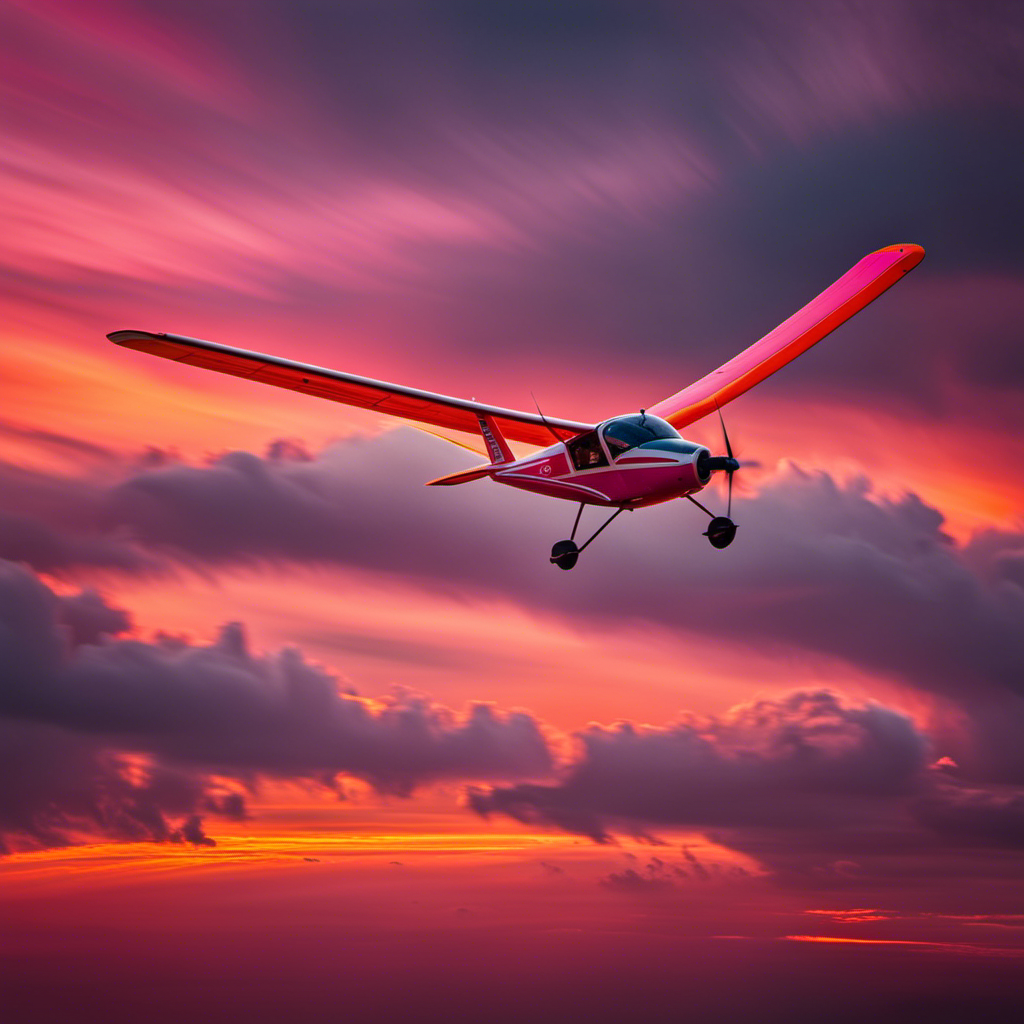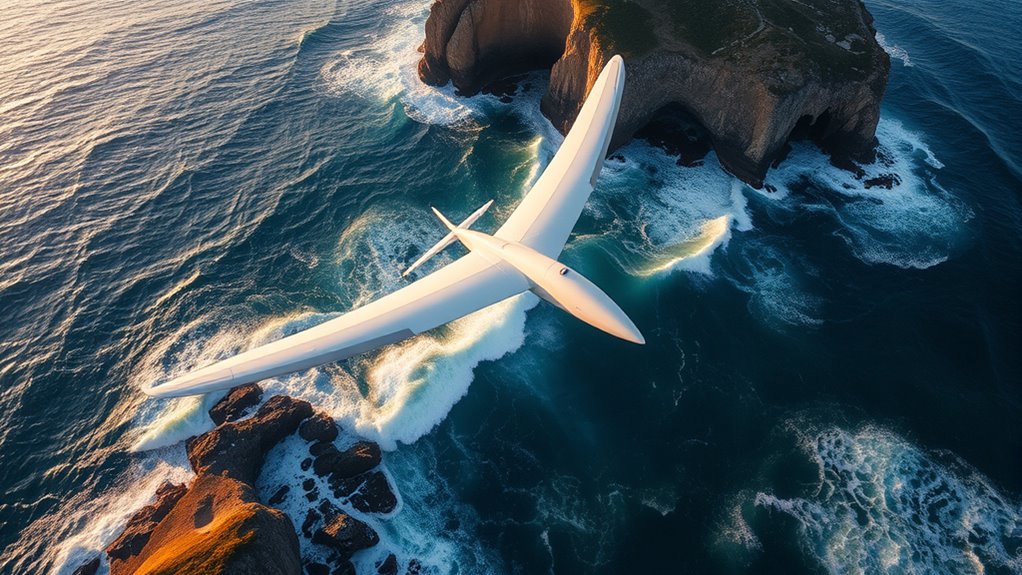
Wave soaring uses strong, steady mountain winds to create predictable atmospheric waves, allowing you to gain altitude by riding these up-and-down air patterns. It relies on terrain interaction and stable, high-velocity air to form powerful lift zones high above the ground. In contrast, thermaling involves circling within rising warm air columns caused by surface heating, which are more variable and less predictable. Understanding these differences helps you choose the right technique; if you keep exploring, you’ll uncover ways to master both methods effectively.

Get travel and outdoor gear delivered free — and shop member deals
- Fast, free delivery on millions of items
- Access to Prime Big Deal Days deals on October 6–7
- Prime Video, Amazon Music and more included
Key Takeaways
- Thermaling involves circling within rising warm air currents, while wave soaring uses atmospheric mountain waves for lift.
- Thermals are typically less stable, variable, and driven by surface heating; wave lift is steady, high-altitude, and generated by terrain-induced waves.
- Thermaling occurs over warmer ground areas with cumulus clouds, whereas wave soaring relies on mountain ridges, wave clouds, and consistent wind patterns.
- Thermaling requires gentle, variable winds; wave soaring depends on strong, steady, high-altitude winds aligned with terrain.
- Pilots use different techniques: circling for thermaling, and climbing along standing waves for wave soaring, with distinct safety considerations.
As an affiliate, we earn on qualifying purchases.
The Basics of Thermaling and Its Role in Gliding

Thermalling is a fundamental skill in gliding, allowing pilots to gain altitude by circling within rising columns of warm air. This process relies on thermal lift, which occurs when the sun heats the Earth’s surface unevenly, creating pockets of warm air that rise. You can often spot these thermals near cloud streets—long rows of cumulus clouds aligned with the wind—where the convergence of warm air enhances lift. By circling within these thermal columns, you stay aloft longer and extend your glide range. Recognizing cloud streets and understanding thermal lift are essential skills for efficient thermaling. Mastering this technique enables you to sustain flight without engine power, making your gliding experience more enjoyable and strategic.
How Wave Soaring Forms and Its Atmospheric Foundations
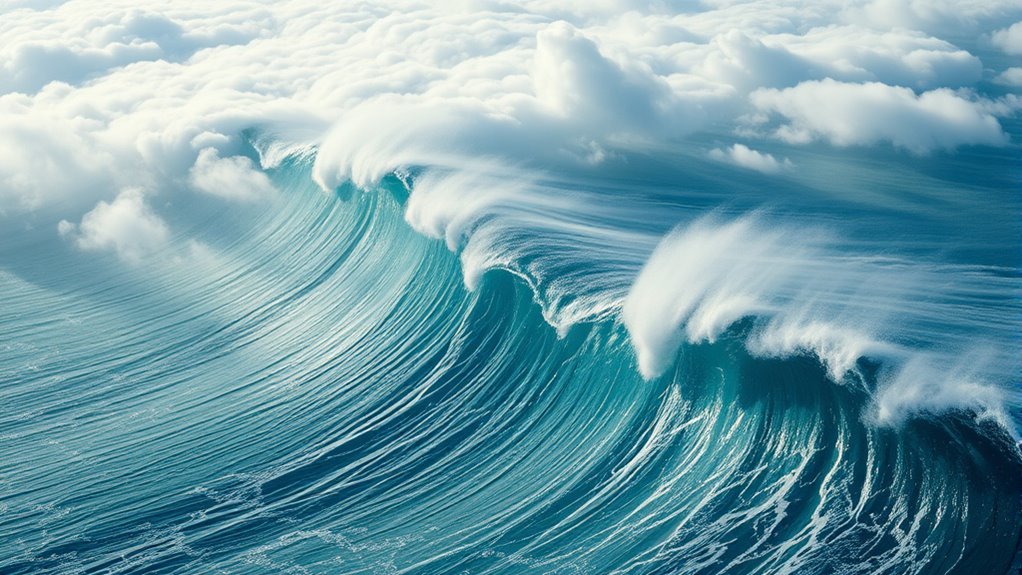
Wave soaring begins with understanding how mountain wind patterns interact with atmospheric pressure changes to create wave formations. These waves form when airflow is disturbed by terrain, causing atmospheric pressure variations that generate standing waves in the sky. Recognizing these mechanics helps you anticipate where to find the best lift for soaring. Additionally, high-altitude wind conditions play a crucial role in sustaining these atmospheric waves and ensuring they remain stable over extended periods.
Mountain Wind Patterns
Have you ever wondered how mountain winds create the perfect conditions for wave soaring? It all starts with mountain wind, which is driven by local wind patterns influenced by terrain. When wind blows across mountain ranges, it accelerates and interacts with the landscape, creating strong, consistent airflow. As air flows over peaks and ridges, it’s forced upward, generating wave-like patterns on the other side. These wind patterns can be predictable, especially during certain weather conditions, forming standing waves that stay stationary relative to the terrain. You’ll often find wave soaring opportunities where these mountain wind patterns produce smooth, powerful lift. Understanding how these winds behave helps you anticipate where to find the best wave lift, making your soaring experience more predictable and exciting. Additionally, the soluble fiber in chia seeds helps in maintaining gut health, which can contribute to overall well-being during demanding physical activities like soaring.
Atmospheric Pressure Changes
Ever wonder how changes in atmospheric pressure help create the conditions for wave soaring? Pressure fluctuations in the atmosphere are crucial to forming the strong, stable air currents you need. As air moves over mountain ridges or terrain, pressure decreases at higher altitudes, prompting pilots to make altitude adjustments to stay within these rising air columns. These pressure changes generate areas of high and low pressure, which influence wind patterns and create wave formations. When pressure drops, the air accelerates upward, providing lift. Conversely, increasing pressure can cause slight descent, making it easier to maintain altitude or gain speed. Understanding these atmospheric pressure variations helps you anticipate where wave conditions will develop and how to adjust your altitude for ideal soaring. Recognizing the role of atmospheric pressure changes enhances your ability to predict and exploit wave formations effectively.
Wave Formation Mechanics
Understanding how atmospheric conditions generate wave formations is key to mastering wave soaring. Waves form when wind encounters a mountain range or obstacle, causing wave reflection that pushes air upward. This reflected airflow interacts with the atmospheric resonance, amplifying the wave’s strength and creating stable lift zones high above the terrain. When wind hits a mountain, it’s deflected upward, generating a series of standing waves on the lee side. These waves can extend for miles, providing soaring pilots with long, smooth lift lines. The key is recognizing how wave reflection and atmospheric resonance work together to sustain these formations. Additionally, wind patterns significantly influence the development and stability of wave formations. By understanding these mechanics, you can better anticipate where to find the strongest, most reliable wave lift for extended flights.
Key Differences in Conditions for Thermaling and Wave Soaring
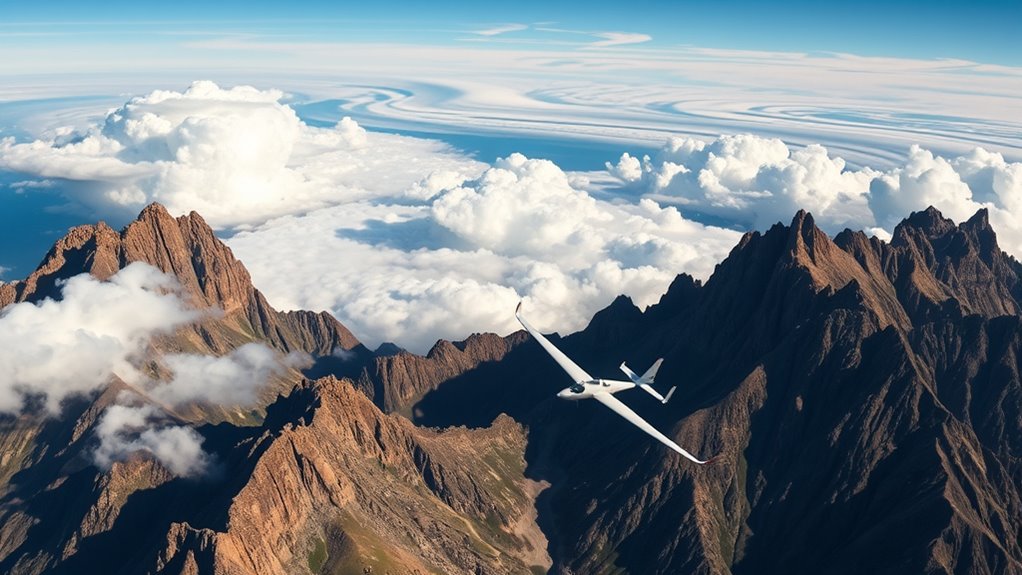
You’ll notice that thermaling and wave soaring require different wind conditions, with thermals needing gentle, rising air and wave soaring demanding stronger, aligned winds. The stability of the air mass also plays a role, as stable air supports sustained wave formation, while less stable air favors thermals. Additionally, terrain and topography influence these conditions, with ridges and mountains shaping the airflow patterns you need for each type of soaring. Water parks often capitalize on topographical features in their design, similar to how soaring pilots utilize terrain to achieve optimal flight conditions.
Wind Speed and Direction
How do wind speed and direction differ between thermaling and wave soaring? In thermaling, wind tends to be gentle and variable, influenced by local terrain and cloud cover, with smaller temperature gradients creating less consistent lift. For wave soaring, you need stronger, more steady winds, often blowing at higher speeds from specific directions, such as from the ocean or mountain ranges. These winds generate strong, organized wave patterns, especially when temperature gradients are sharp, producing distinct cloud formations like rotor clouds. The wind direction remains steady over longer distances, enabling the development of consistent wave systems. Understanding these differences helps you anticipate lift conditions, ensuring you choose the right flying strategy for each environment.
Air Mass Stability
Air mass stability plays a pivotal role in shaping the conditions for thermaling and wave soaring. In stable air masses, vertical movement is limited, making thermaling challenging because thermals rely on rising warm air. Conversely, stable conditions are essential for wave soaring, as they create the smooth, undisturbed air needed for large, steady waves. When the air mass is unstable, thermals become more vigorous and unpredictable, favoring thermaling. Stable air suppresses turbulence, allowing for longer, more consistent wave flights. Recognizing these differences helps you anticipate the flying conditions. For thermaling, look for unstable or neutral stability, while stable air mass conditions are better suited for wave soaring. Understanding the stability of the air mass helps you anticipate the flying conditions, especially when considering air mass characteristics and their impact on flight performance. Recognizing these differences allows you to choose the right technique for the prevailing environment.
Terrain and Topography
Terrain and topography considerably influence the conditions suitable for thermaling and wave soaring. Mountain terrain and distinct topographical features create different lift mechanisms you can exploit. Thermaling often occurs over rolling hills or flat land with thermals forming near surface heat sources. In contrast, wave soaring relies on mountain terrain and features like ridges or escarpments that generate strong, steady waves. Hydrogen fuel cells can produce clean energy in various environments, making understanding terrain effects even more crucial for sustainable flying. Understanding these features helps you choose the right terrain for your soaring style.
Techniques and Skills Needed for Effective Thermaling
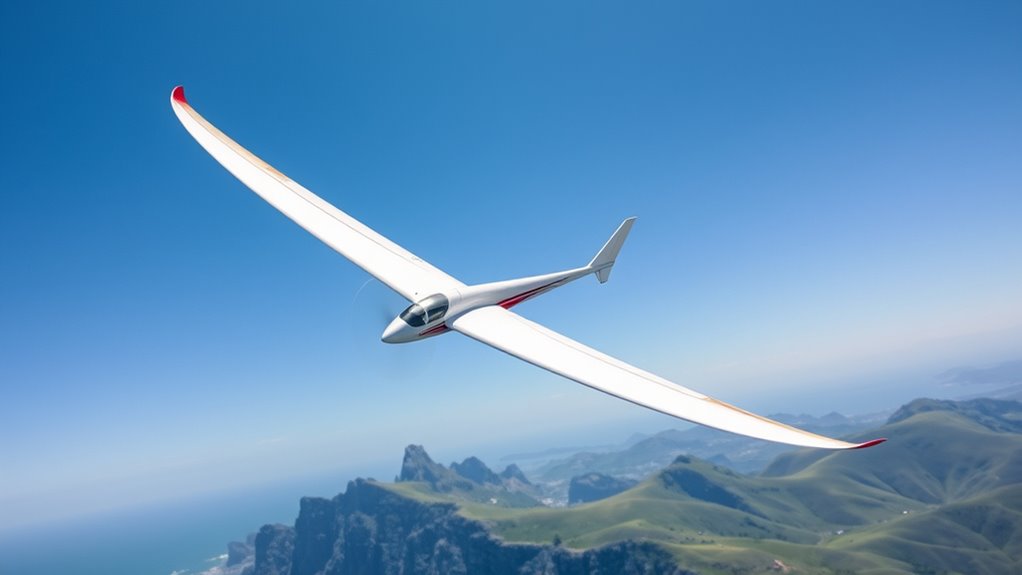
Mastering effective thermaling requires you to develop specific techniques and skills that maximize your ability to stay aloft. Focus on honing thermaling techniques like maintaining a steady circle, adjusting your bank angle, and keeping your nose slightly down to stay in the core. Smooth, consistent control inputs help you stay centered in the lift. Your thermaling equipment, including a sensitive variometer, is essential for detecting subtle lift changes. Use it to identify the strongest lift zones and make precise turns. Practicing patience and situational awareness is key—knowing when to circle and when to move on increases your efficiency. Additionally, understanding the best anime movies can inspire patience and focus during long thermaling sessions. With experience, you’ll learn to interpret thermals quickly and adjust your flight path for sustained altitude, making your thermaling more effective and enjoyable.
Navigating and Exploiting Wave Patterns for Extended Flight
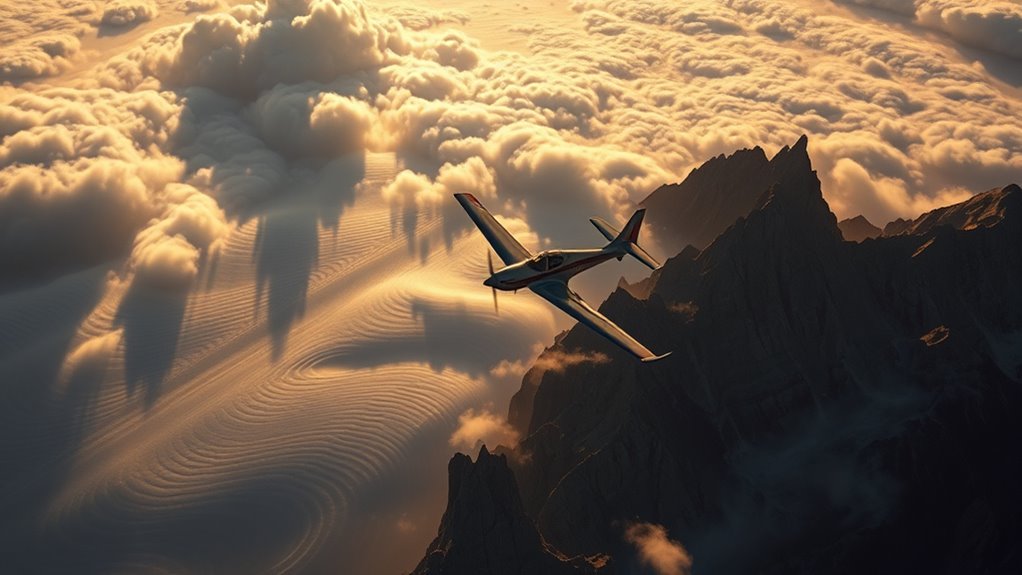
Understanding wave patterns is key to extending your flight distance and altitude. To do this, you need to interpret weather forecasting data accurately, identifying where wave activity is strongest. Use visual cues such as mountain ridges, cloud formations, and wind direction to locate potential wave zones. Once you find a promising area, focus on altitude management by climbing steadily within the wave’s core, avoiding unnecessary energy loss. Pay attention to signs of wave stability, like smooth, steady lift, and adjust your glide path accordingly. Exploiting the vertical currents efficiently allows you to stay aloft longer and reach higher altitudes. Developing this skill requires practice with weather forecasting tools and an understanding of atmospheric patterns, ultimately enabling you to navigate wave systems confidently for extended flights. Additionally, honing your ability to recognize weather forecasting data can significantly improve your success in locating optimal wave lift zones.
Safety Considerations in Wave Soaring Versus Thermaling

While exploiting wave patterns can lead to impressive altitude gains, it also introduces specific safety challenges compared to thermaling. You need to stay alert to sudden weather changes and maintain your glider properly to prevent mechanical issues. Here are key safety considerations:
- Weather forecasting: Accurate predictions help you avoid severe turbulence or strong wind shear that can be dangerous at high altitudes.
- Glider maintenance: Regular checks ensure your equipment is reliable, reducing the risk of in-flight failures during demanding wave conditions.
- Altitude awareness: Keep a close eye on your altitude and oxygen levels if needed, as wave soaring often occurs at higher elevations where hypoxia can threaten safety.
- Regional weather patterns: Understanding local weather patterns can help anticipate sudden changes that are critical for safe wave soaring.
Being prepared and vigilant helps you navigate the unique risks of wave soaring confidently.
Practical Tips for Pilots Looking to Try Both Methods

If you want to experience both thermaling and wave soaring, start by familiarizing yourself with the fundamental differences between the two methods. Pay attention to cloud formation; thermals often produce cumulus clouds, while wave clouds indicate strong wave activity. During pilot training, focus on understanding these visual cues and how they relate to lift sources. Practice reading the sky to identify potential wave or thermal zones before launching. Gradually build your skills by flying with experienced pilots who can guide you through the nuances of each method. Keep a log of your flights, noting cloud types, weather conditions, and lift quality. This will help you develop a solid mental map, making it easier to switch between thermaling and wave soaring confidently.
Frequently Asked Questions
Can a Pilot Switch Seamlessly Between Thermaling and Wave Soaring Mid-Flight?
You can switch between thermaling and wave soaring mid-flight, but it’s not always seamless. Shift challenges include adjusting your approach and understanding changing lift sources. You might need equipment modifications, like different variometers or antennas, to optimize performance in each mode. Staying alert and flexible helps you adapt quickly, ensuring you maximize your soaring experience without losing altitude during these shifts.
What Are the Most Common Misconceptions About Wave Soaring?
Imagine you’re a pilot in the 1800s, thinking wave soaring is just fancy thermaling. Many misconceptions about lift persist, like believing wave soaring is only for experts or that it’s uncontrollable. In reality, wave soaring myths often overstate difficulty, but it’s a skill anyone can learn with practice. People often overlook how predictable wave lift can be, making it accessible beyond the myth that it’s only for seasoned aviators.
How Does Weather Prediction Differ for Wave Soaring Compared to Thermaling?
When predicting weather for wave soaring, you focus on specific weather patterns like strong, consistent winds and atmospheric pressure changes. Unlike thermaling, forecast models emphasize wind shear and wave formation, which are essential for catching lift at higher altitudes. You need to interpret detailed data, such as vertical wind profiles, to anticipate wave conditions. This specialized approach helps you plan flights effectively in areas with complex, dynamic weather.
Are Certain Glider Models Better Suited for Wave Soaring?
Certain glider models are better suited for wave soaring because of their design features. You’ll want a glider with a high aspect ratio and strong performance capabilities, which help you stay aloft longer in wave conditions. Your pilot experience also plays a role; skilled pilots can optimize these advanced gliders for wave soaring, handling complex lift and turbulence efficiently. So, both glider design and your experience make a big difference.
What Training or Certifications Are Recommended for Wave Soaring Enthusiasts?
To excel in wave soaring, you should pursue advanced certification and safety training specific to this discipline. These programs enhance your skills, teach you how to handle high-altitude conditions, and improve your decision-making in challenging environments. It is crucial to build a solid foundation through thorough training, ensuring you’re prepared for the unique aspects of wave soaring. This preparation boosts confidence, safety, and overall enjoyment during your soaring adventures.
Conclusion
Don’t let the complexity of wave soaring hold you back—it’s a thrilling challenge that can uncover incredible airtime and new horizons. With patience and practice, you’ll gain confidence in both thermaling and wave techniques, opening doors to breathtaking flights and unforgettable experiences. Remember, every expert was once a beginner. Embrace the learning process, and soon you’ll be riding soaring waves of the sky, feeling truly free and alive.
Halloween Picks
halloween
As an affiliate, we earn on qualifying purchases.