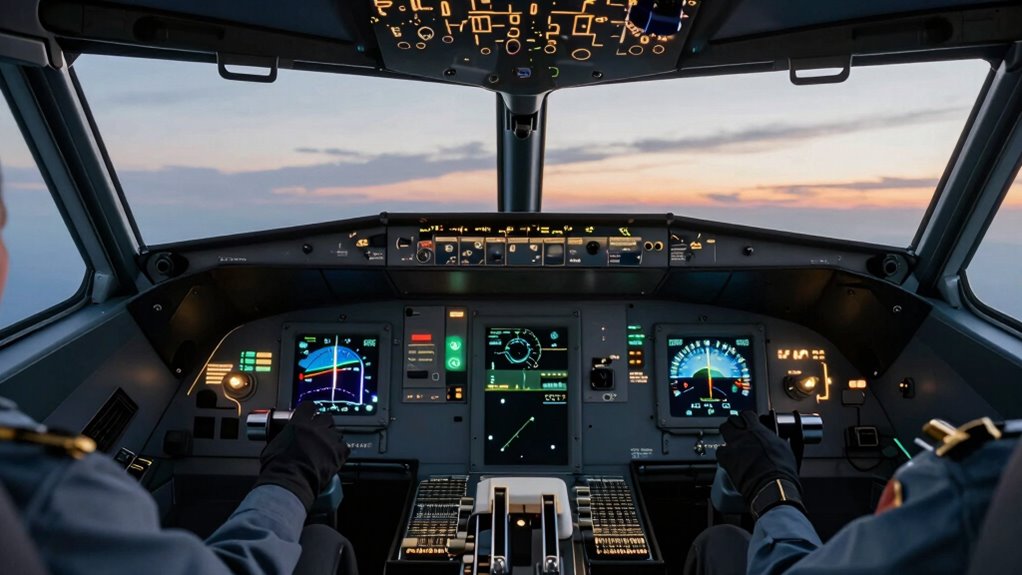
As an advanced pilot, you constantly monitor terrain features, weather patterns, and aircraft behavior without saying a word. You keep an eye on your instruments for fuel levels, engine health, and mechanical cues, while intuitively responding to wind, temperature, and environmental changes. Your awareness of subtle cues helps you make proactive decisions and avoid hazards. If you want to discover more about how expert pilots stay alert and responsive, keep exploring these essential skills.
Key Takeaways
- Continuously monitor terrain, obstacles, and environmental cues to anticipate hazards without verbal communication.
- Instinctively track fuel consumption relative to flight conditions for strategic decision-making.
- Subconsciously assess aircraft performance through mechanical cues and instrument feedback.
- Read wind patterns, weather changes, and environmental signs to adjust flight plans proactively.
- Seamlessly integrate situational data for safe navigation, reacting instinctively to unspoken signals.
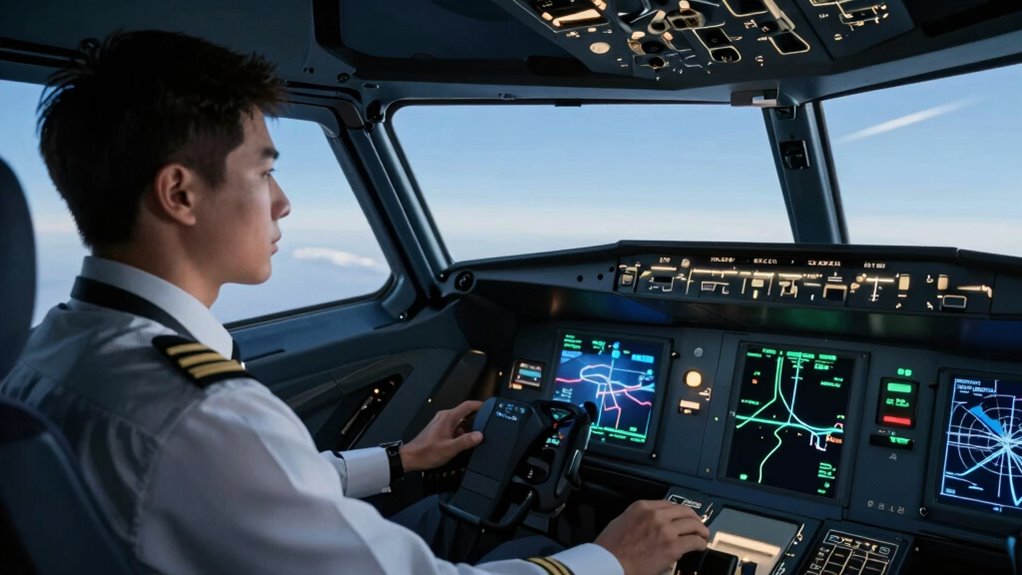
In the high-stakes world of aviation, advanced pilots often track a range of subtle cues without uttering a word—these unspoken signals are essential for maintaining safety and situational awareness. You pay close attention to your surroundings, constantly monitoring terrain awareness to guarantee your flight path stays clear of obstacles, mountains, or changing landscape features. You instinctively interpret the terrain’s shape, slope, and elevation, using your peripheral vision and instruments to anticipate potential hazards before they become critical. This mental map allows you to make swift adjustments, maintaining a safe altitude and avoiding surprises, especially in challenging environments like mountainous regions or low visibility conditions.
Alongside terrain awareness, you’re equally vigilant about your fuel consumption. You don’t need to ask; you know your aircraft’s fuel burn rate based on engine performance, power settings, and flight conditions. You track your fuel usage continuously, comparing real-time consumption against your planned reserves. This helps you decide whether to proceed, adjust your route, or prepare for an early landing. You’re also aware of how factors like altitude, speed, and weather influence fuel burn, so you make strategic decisions based on these subtle cues. If fuel consumption unexpectedly increases, you interpret it as a sign to check for issues like engine inefficiency or increased drag, prompting you to take corrective action before it becomes a problem.
Monitoring fuel consumption helps you make strategic decisions and address issues proactively before they impact safety or efficiency.
You also pay attention to your aircraft’s behavior—listening for any unusual engine noise or vibrations that might indicate mechanical issues. These cues often happen without your consciously noticing, but you’ve trained yourself to pick up on them intuitively. Simultaneously, your eyes scan gauges and instrument panels, but your overall sense of the aircraft’s performance guides your focus. You develop a mental picture of how your plane should behave under current conditions, allowing you to detect anomalies early. Additionally, experienced pilots use their knowledge of aircraft systems to interpret subtle cues and ensure everything is functioning properly. Being familiar with the aircraft’s normal operating ranges helps you distinguish between routine variations and potential problems. Recognizing and interpreting these signals quickly is vital for preventative maintenance and safety.
Furthermore, seasoned pilots subconsciously track environmental factors, such as wind patterns and temperature changes, which influence flight performance and fuel efficiency. Your situational awareness extends to understanding the environment and your aircraft’s interaction with it. You read the wind drift, observe the aircraft’s response to control inputs, and anticipate how weather changes might affect your flight. You also develop an intuitive understanding of weather patterns, which helps you anticipate changes that could impact your route or altitude. All these factors—terrain, fuel, aircraft performance—are tracked subconsciously but are crucial for safe navigation. Mastering these unspoken signals enables you to react swiftly, make informed decisions, and keep your flight smooth and safe without having to verbalize every detail.
aviation head-up display HUD
As an affiliate, we earn on qualifying purchases.
As an affiliate, we earn on qualifying purchases.
Frequently Asked Questions
How Do Advanced Pilots Develop Their Situational Awareness Skills?
You develop your situational awareness skills by continuously monitoring your cockpit communication and staying alert to changing conditions. During flight planning, you anticipate potential issues and strategize responses. In-flight, you actively scan instruments, observe weather, and communicate effectively with your crew. This constant vigilance helps you detect anomalies early, adapt quickly, and maintain control, ensuring safety without needing to talk about it—it’s all about ingrained awareness and proactive thinking.
What Tools Do Advanced Pilots Use to Monitor Their Aircraft Systems?
You use aircraft instrumentation and flight data monitoring tools to keep a constant eye on your aircraft systems. Instruments like engine gauges, altitude indicators, and airspeed indicators provide real-time data, while flight data monitoring systems track trends and detect anomalies. This continuous monitoring helps you quickly identify issues, make informed decisions, and maintain safety, even without actively discussing or thinking about every detail.
How Do Pilots Maintain Focus During Long Flights Without Verbal Communication?
Imagine a steady lighthouse beam guiding your journey—your focus stays sharp during long flights. You rely on cockpit ergonomics to minimize distractions, keeping essential controls within reach. Crew communication protocols act like silent signals, ensuring smooth coordination without words. You intuitively read subtle cues, maintaining situational awareness. This harmony between environment and procedures helps you stay alert and focused, steering extended hours with confidence and calm.
What Non-Verbal Cues Do Pilots Rely on for Effective Team Coordination?
You rely on non-verbal cues like hand signals and eye contact for effective team coordination. Hand signals communicate immediate instructions or status updates, especially when radio silence is necessary. Eye contact helps confirm understanding and maintains situational awareness without words. These cues keep you synchronized with your crew, ensuring smooth operations and quick responses, even in noisy or high-stress situations where verbal communication might be limited or impractical.
How Do Pilots Anticipate and React to Potential In-Flight Emergencies Silently?
You anticipate and react to potential in-flight emergencies through emotional intelligence, recognizing subtle cues from your crew and aircraft. Your decision-making agility allows you to adapt quickly, evaluating situations calmly and efficiently. By maintaining situational awareness, you silently coordinate responses, trusting your training and instincts. This proactive approach helps you stay prepared, ensuring swift, effective actions without the need for overt communication, ultimately enhancing safety and teamwork during critical moments.
aircraft terrain awareness system
As an affiliate, we earn on qualifying purchases.
As an affiliate, we earn on qualifying purchases.
Conclusion
You’re constantly weaving through the invisible currents of information, like a skilled dancer feeling the rhythm beneath your feet. Without uttering a word, you track every subtle shift—weather whispers, aircraft whispers, your own instincts whisper back. It’s a silent symphony only seasoned pilots hear and understand. Mastering this unspoken language keeps you steps ahead in the skies, turning chaos into harmony. In this silent ballet, your awareness becomes your most powerful instrument.
pilot weather monitoring tools
As an affiliate, we earn on qualifying purchases.
As an affiliate, we earn on qualifying purchases.
aircraft fuel management system
As an affiliate, we earn on qualifying purchases.
As an affiliate, we earn on qualifying purchases.