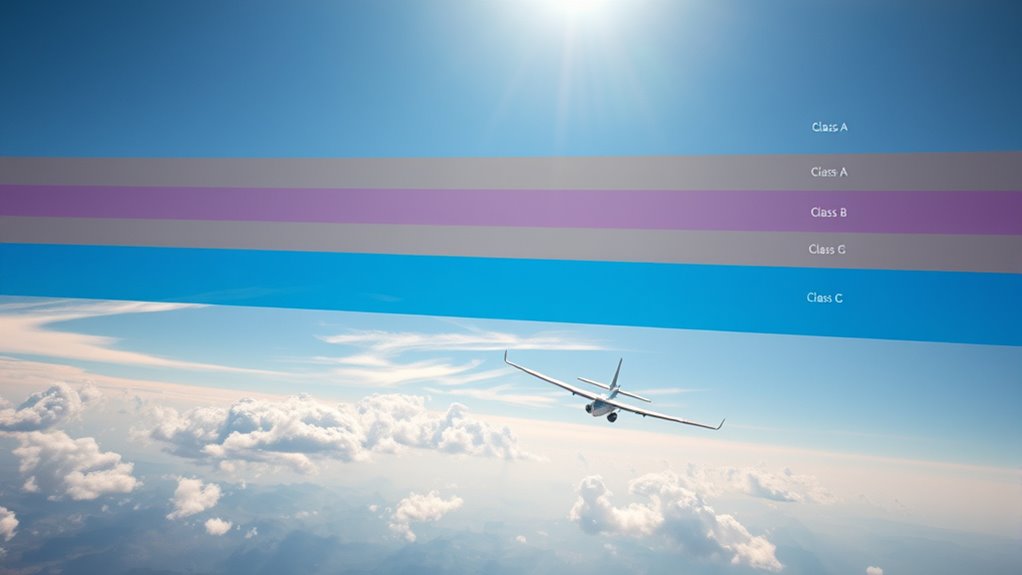

Understanding airspace classes is essential for safe navigation. Controlled airspace (A, B, C, D) offers air traffic management and requires communication with controllers, especially for IFR flights. Uncontrolled airspace (E, G) gives more freedom but demands that you follow specific rules. VFR flights are mainly in less crowded zones, while IFR flights operate in busy, controlled areas. If you want to master these zones, you’ll find more helpful details ahead.
Key Takeaways
- Airspace classes range from controlled (A-D) to uncontrolled (E-G), each with specific traffic management rules.
- Class A airspace requires IFR flight plans and ATC clearance, typically at high altitudes.
- Classes B, C, and D involve varying levels of ATC control, mainly around busy airports.
- Class E and G are uncontrolled zones where pilots operate with more autonomy, often VFR.
- Understanding airspace classes helps pilots plan routes, ensure safety, and comply with regulations.
airspace class charts
As an affiliate, we earn on qualifying purchases.
As an affiliate, we earn on qualifying purchases.
Understanding Airspace Classifications and Flight Rules

Have you ever wondered how air traffic is organized and managed across different regions? It’s a complex system designed to keep pilots and passengers safe, efficient, and organized. To understand this system, you need to grasp the basics of airspace classes, which are divided based on the level of control and the types of flights that operate within them. A key distinction is between VFR vs IFR flights, which refers to whether pilots are flying visually or relying on instruments. VFR, or Visual Flight Rules, are when pilots navigate by sight, usually during good weather, and typically operate in less crowded, uncontrolled airspace. IFR, or Instrument Flight Rules, come into play when weather conditions limit visibility, requiring pilots to rely on instruments and air traffic control (ATC) guidance. This distinction is vital because it influences the type of airspace the aircraft can operate in and whether that airspace is controlled or uncontrolled.
When you look at airspace classes, you’ll notice that some are designated as controlled, while others are uncontrolled. Controlled airspace includes Classes A, B, C, and D, where ATC services are provided to manage traffic flow and guarantee safety. In these zones, pilots must communicate with controllers, follow instructions, and often file IFR plans, even if they intend to fly VFR. This helps prevent collisions and coordinate traffic, especially in busy areas. On the other hand, uncontrolled airspace, which mainly covers Classes E and G, offers more freedom. Pilots can operate without direct ATC guidance, making VFR flights common here. However, they’re still responsible for maintaining safe separation from other aircraft and adhering to the rules.
Understanding whether you’re flying VFR or IFR in a given airspace is essential for safety and legal compliance. Controlled airspace is often designated for busy airports and densely trafficked regions, where IFR is the standard for managing the volume of flights. Uncontrolled airspace is more typical in rural or less congested areas, allowing pilots to fly VFR with less formal oversight. As a pilot or someone learning about aviation, recognizing these differences helps you plan flights better, choose the right routes, and understand the responsibilities involved. Whether you’re flying in controlled airspace under IFR or enjoying the freedom of uncontrolled zones with VFR, knowing the rules and classifications guarantees you navigate with confidence and safety. Ultimately, airspace classes form the backbone of orderly air traffic management, balancing safety, efficiency, and flexibility across diverse flying environments.
pilot communication headsets
As an affiliate, we earn on qualifying purchases.
As an affiliate, we earn on qualifying purchases.
Frequently Asked Questions
How Do Pilots Determine the Airspace Class They Are Flying In?
You determine the airspace class you’re flying in by checking aviation charts and airspace identification tools. These resources show the boundaries, rules, and classifications for each area. As a pilot, you use this information for navigation and to guarantee compliance with airspace regulations. By understanding the airspace class, you can plan your route safely and avoid restricted or controlled zones, keeping your flight smooth and legal.
Are There Specific Restrictions for Drone Operations in Different Airspace Classes?
Diving into drone directives, you’ll discover definite restrictions across different airspace classes. In no-fly zones and restricted zones, you’re prohibited from operating without special permissions. Always check for clearances and restrictions before taking off, especially near airports or sensitive areas. Different classes impose distinct rules, so understanding these boundaries helps you avoid fines or flight interruptions. Stay savvy, stay safe, and respect the regulations to keep your drone flights trouble-free.
How Do Airspace Classes Impact Emergency Response Procedures?
In an airspace emergency, your response coordination is vital. Different airspace classes dictate how quickly you can react and what procedures to follow. For example, in controlled airspace, you’ll need to notify authorities immediately, while uncontrolled areas give you more flexibility. Understanding these impacts helps you act swiftly and safely, minimizing risks and ensuring effective emergency response. Your awareness of airspace classes enhances safety during critical situations.
Can a Pilot Switch Between Airspace Classes During a Flight?
Imagine switching airspace classes mid-flight like flipping a switch—can you really do that? Well, not exactly. Under airspace regulations, you can’t just hop between classes freely. You need pilot authorization for certain shifts, especially when moving into busier or more restrictive zones. So, while it’s not impossible, you must plan carefully, follow regulations, and get proper approval to change airspace classes safely and legally during your flight.
What Training Is Required to Operate in Restricted or Prohibited Airspace?
To operate in restricted or prohibited airspace, you need specialized training on airspace regulations and a specific pilot certification if required. You’ll learn about the restrictions, permissions, and procedures to guarantee safety and compliance. This training helps you understand how to request clearance, communicate with air traffic control, and avoid violations. Without this knowledge and certification, flying in these areas is illegal and can lead to serious consequences.
VFR IFR flight planning tools
As an affiliate, we earn on qualifying purchases.
As an affiliate, we earn on qualifying purchases.
Conclusion
So, now that you’re armed with the secrets of airspace classes, feel free to navigate the skies like a seasoned pilot—just don’t forget your map, your sense of humor, and maybe a parachute for when things get a little too complicated. Remember, flying through these airspace zones is almost as easy as avoiding traffic on your morning commute—if your commute involved dodging airplanes and obeying a whole lot of rules. Happy flying, airspace explorer!
air traffic control radio
As an affiliate, we earn on qualifying purchases.
As an affiliate, we earn on qualifying purchases.