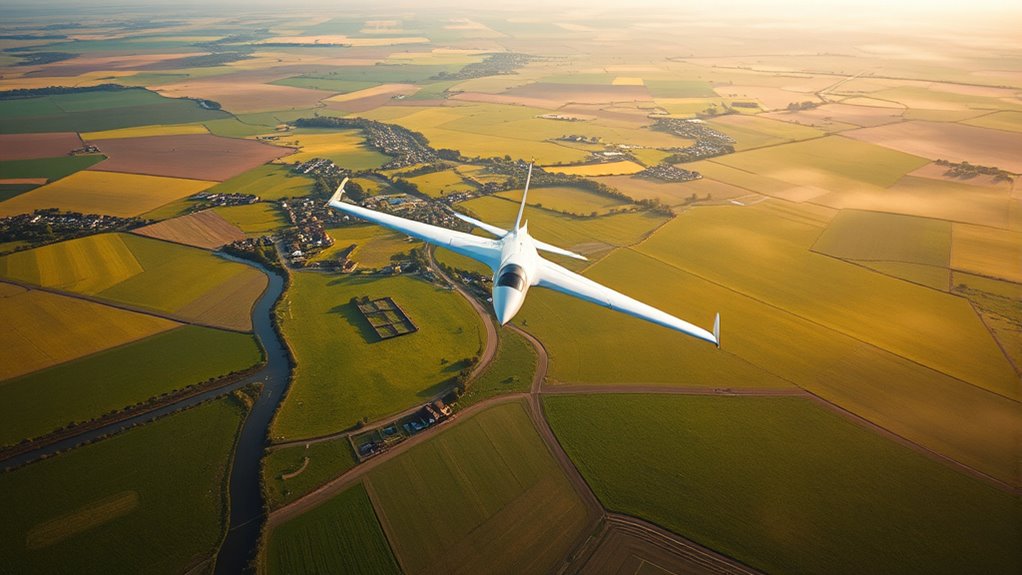

Flying over Denmark’s flatlands demands sharp observation and strategic flying to maximize weak thermals. Look for subtle cues like changes in wind, cloud formations, and landscape features such as trees and water surfaces. Circle carefully within these faint lift zones and conserve your energy. Patience is key, and small adjustments can help you stay aloft longer. If you keep honing your skills, you’ll discover how to make the most of these delicate updrafts to extend your flight.

Get travel and outdoor gear delivered free with Prime
- Fast, free delivery on millions of items
- Prime Video, Amazon Music and more included
- Member-only deals all year
Key Takeaways
- Develop sharp observational skills to detect subtle atmospheric cues like cloud patterns and wind shifts indicating weak lift zones.
- Use landscape features such as water bodies, forests, or trees as indicators for potential thermals.
- Circle carefully within small thermal bubbles, conserving energy and gradually gaining altitude.
- Constantly adjust your position based on environmental cues to stay within areas likely to produce lift.
- Prioritize patience and strategic thermal utilization to maximize flight duration despite weak and sporadic thermals.

Flying over Denmark’s flatlands offers a surreal perspective on the country’s expansive, open landscapes. You’ll notice the gentle undulations and patchwork fields stretching as far as the eye can see, with little to no significant elevation changes. This scenery makes thermal soaring more challenging but also more rewarding when you master it. Since Denmark’s terrain lacks tall hills or mountains, you’ll rely heavily on your ability to identify and use weak thermals for sustained flight. Your success depends on sharp landscape navigation, discerning subtle air currents that form over flat terrain, and making the most of every thermal lift.
Flying over Denmark’s flatlands reveals subtle thermals and expansive fields, demanding keen navigation and patience for successful soaring.
In these conditions, understanding how to maximize weak thermals becomes essential. Unlike in mountainous regions, where strong and predictable thermals are common, Denmark’s thermals are often faint and sporadic. You need to develop a keen eye for signs of lift—slight variations in cloud formations, changes in wind direction, or even the way grass or crops ripple in the breeze. When you find a thermal, it might not be a towering updraft; instead, it could be a gentle bubble of rising air that you need to carefully circle within to gain altitude. Patience and precision become your best tools here, as you wait for the right moment to connect with these weak thermals and climb higher.
Landscape navigation plays a key role in this environment. You’ll want to familiarize yourself with the landscape features that can help guide your thermal search. Fields, forests, and water bodies can influence local airflow, creating subtle lift zones. For example, a line of trees might act as a trigger for thermal formation, while open water surfaces can generate rising air currents on breezy days. As you traverse the flatlands, keep your eyes open for these cues. Use your GPS and topographical maps to plan your route, aiming to stay within areas where thermals are more likely to form. Constantly adjusting your position based on the landscape and atmospheric cues ensures you stay in lift longer and avoid unnecessary glides. Recognizing the airflow patterns created by different landscape features can greatly improve your thermal detection and efficiency.
Balancing your energy and conserving altitude is imperative when thermal soaring over Denmark’s flatlands. Since thermals are weak, you need to be strategic about when and where to circle and how long to stay in each thermal. Knowing how to read the landscape and interpret subtle atmospheric signals helps you make informed decisions, allowing you to extend your flight and cover more ground. With patience, sharp landscape navigation, and an attentive eye for weak thermals, you can enjoy a smooth, efficient flight across Denmark’s flatlands, experiencing the thrill of flight even in the absence of dramatic elevation changes.
paragliding thermal detection equipment
As an affiliate, we earn on qualifying purchases.
As an affiliate, we earn on qualifying purchases.
Frequently Asked Questions
What Equipment Is Best for Thermal Soaring in Flatlands?
To excel in thermal soaring over flatlands, you need a glider optimized for aerodynamics, with a sleek design that reduces drag and enhances lift. Use thermal mapping tools to locate weak thermals accurately, increasing your chances of staying aloft longer. Lightweight, sensitive variometers help detect subtle lift changes, while a good glide ratio maximizes your efficiency. Together, these tools and a well-designed glider boost your success in weak thermal conditions.
How Do Weather Patterns Influence Thermal Formation in Denmark?
Did you know that Denmark’s weather patterns markedly impact thermal formation? The jet stream influences air mass interactions, creating pockets of rising warm air essential for thermals. When the jet stream shifts, it can either enhance or weaken thermal activity, making soaring more challenging or easier. You’ll find that understanding these patterns helps you anticipate weak thermals and optimize your flight strategy across Denmark’s flatlands.
Are There Specific Times of Year Optimal for Flying in Denmark’s Flatlands?
You’ll find the best flying conditions in Denmark’s flatlands during late spring and early summer when seasonal wind patterns align with peak thermal activity timing. During these months, warmer days and stable weather create stronger thermals, making soaring easier. Avoid late autumn and winter, as colder temperatures and less predictable wind patterns reduce thermal strength, making flying less efficient. Plan your flights around these ideal seasons for the best experience.
How Can Pilots Improve Their Thermal Detection Skills?
You can improve your thermal detection skills by sharpening your observational skills through pilot training, focusing on visual cues like bird activity, cloud formations, and wind shifts. Remember, it’s all about playing a game of “Where’s the lift?”—a game only the most attentive pilots win. Don’t rely solely on instruments; embrace your inner hawk, and you’ll spot weak thermals before they vanish, making your flight smoother and more confident.
What Safety Precautions Are Recommended for Weak Thermal Conditions?
When flying in weak thermal conditions, you should prioritize pilot communication and emergency preparedness. Maintain constant contact with your team to share thermal sightings and avoid surprises. Carry essential safety gear, such as radios, GPS, and emergency supplies. Be alert to changing weather patterns, and plan alternative routes if thermals weaken unexpectedly. Staying vigilant and prepared guarantees your safety, allowing you to respond quickly to any thermal-related challenges.
Conclusion
As you glide over Denmark’s endless flatlands, remember that even the faintest thermals can lift you higher, turning the mundane into the extraordinary. Like a whisper in the wind, these weak currents whisper secrets of altitude and adventure. Embrace the challenge, and let the landscape’s subtle currents carry you beyond the horizon’s edge. In this vast, open canvas, your skill transforms the invisible into a symphony of flight—proof that sometimes, less truly is more.
Columbus Day / Indigenous Peoples' Day Picks
long weekend sales
As an affiliate, we earn on qualifying purchases.