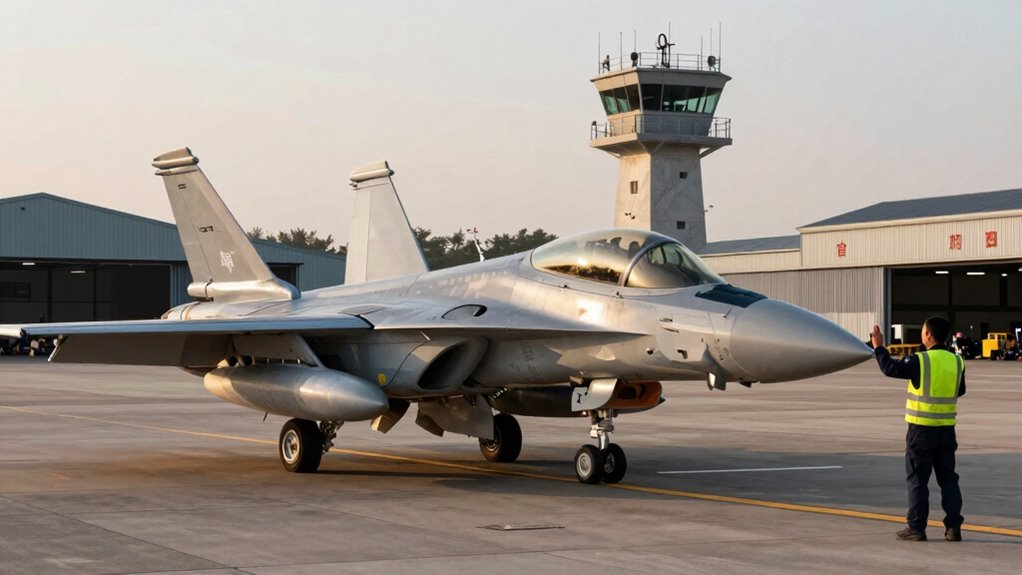

To understand the language pilots use at the airfield, familiarize yourself with standardized phrases, abbreviations, and aviation slang. Pay attention to key commands like “cleared to land” or “request pushback,” and learn common phrases such as “in sight” or “standby.” Recognizing these terms helps you follow conversations and procedures smoothly. Keep exploring, and you’ll uncover more about how pilot communication keeps airfield operations clear and efficient.

Get travel and outdoor gear delivered free with Prime
- Fast, free delivery on millions of items
- Prime Video, Amazon Music and more included
- Member-only deals all year
Key Takeaways
- Learn common aviation phrases and their meanings to interpret instructions accurately.
- Familiarize yourself with standard abbreviations and slang used by pilots and controllers.
- Understand the purpose of concise communication to grasp the sequence of flight operations.
- Recognize key signals like “In sight” or “Wilco” to assess safety and compliance.
- Practice listening to real or recorded radio exchanges to improve situational awareness.

Understanding pilot language can seem intimidating at first, but with a few key insights, you’ll start to recognize the terminology and phrases pilots use during flights. When you listen to flight communication, it often sounds like a different language—quick, clipped, filled with acronyms and aviation slang. But once you understand the basics, it becomes much easier to follow along and grasp what’s happening in the cockpit or at the airfield.
Most of the communication you hear is designed for clarity and brevity. Pilots and air traffic controllers stick to specific phrases to avoid misunderstandings. For example, instead of saying, “We’re heading toward runway 27,” they might say, “Cleared to land runway 27,” or, “Runway 27, cleared to land.” These standardized phrases help everyone stay on the same page, even in stressful or busy situations.
Pilots and controllers use concise, standardized phrases to ensure clear communication in busy or stressful situations.
Aviation slang often includes abbreviations and codes that streamline communication. You might hear “Roger” to mean “I understand,” or “Wilco” to indicate “I will comply.” “Mayday” and “Pan-Pan” are emergency signals, but for routine communication, pilots use a range of shorthand. For example, “Standby” means the pilot or controller will wait briefly before continuing. “Taxi to holding point” directs a pilot to move the aircraft to a designated position on the ground. Recognizing these terms helps you understand what’s happening without needing a full aviation dictionary nearby.
Flight communication isn’t just about understanding words; it’s about interpreting intent. When a controller gives instructions, they’re often concise but packed with meaning. If you hear “Cross runway 27 at Taxiway Alpha,” it tells the pilot exactly where to cross, with no room for misinterpretation. Similarly, pilots use phrases like “Request pushback” to ask ground crews for permission to move the aircraft away from the gate. Additionally, understanding standardized phrases can help you make sense of the concise instructions pilots and controllers rely on daily. Recognizing common aviation abbreviations can further improve your comprehension of routine exchanges.
Getting familiar with common phrases and slang can also help you anticipate what’s coming next in the sequence of events. If you hear “Climb and maintain 10,000,” you know the aircraft is ascending to a specific altitude. When pilots report “In sight,” it indicates they can visually see the runway or other aircraft, which is essential for safety. Developing an awareness of aero-communication can significantly enhance your understanding of aviation routines.
aviation radio communication headset
As an affiliate, we earn on qualifying purchases.
As an affiliate, we earn on qualifying purchases.
Frequently Asked Questions
What Are Common Radio Communication Abbreviations Used by Pilots?
You’ll hear common radio communication abbreviations like “ETA” for estimated time of arrival, “Acknowledge” as “ACK,” and “Roger” to confirm receipt. These abbreviations follow radio protocol to guarantee phraseology clarity, preventing misunderstandings. Pilots also use “Standby” to pause communication and “Wilco” indicating they will comply. Mastering these abbreviations helps you understand pilots’ messages quickly and keeps communication efficient and safe.
How Do Pilots Handle Miscommunications During a Flight?
Did you know that 70% of aviation accidents involve miscommunication? When you encounter miscommunications during a flight, pilots handle it through miscommunication prevention strategies and communication clarity techniques. You should clarify instructions, repeat key information, and confirm understanding. If confusion persists, you’re encouraged to ask for clarification immediately, ensuring everyone stays on the same page. These practices help maintain safety and smooth flight operations, even when misunderstandings occur.
What Is the Significance of Standard Phraseology in Aviation?
Standard phraseology is essential in aviation because it guarantees clear, concise communication, reducing misunderstandings. You rely on aviation communication protocols that standardize how pilots and controllers exchange information. This consistency also reflects pilot language evolution, making interactions more efficient and safe. By using standardized terms, you help prevent errors, improve coordination, and maintain smooth operations, especially in high-pressure situations, ultimately safeguarding everyone on board and on the ground.
How Can I Learn Pilot Language as a Beginner?
To learn pilot language as a beginner, delve into aviation jargon and pilot slang through books, online courses, or apps tailored for aviation enthusiasts. Practice listening to ATC recordings or pilot radio chatter to familiarize yourself with real-world usage. Join aviation forums or local flying clubs where you can ask experienced pilots questions. Consistent practice and immersion will help you become comfortable with the terminology and communication style used at the airfield.
Are There Differences in Terminology Between Different Countries’ Airfields?
Yes, there are differences in terminology between countries’ airfields due to regional language variations, but international aviation standards help maintain consistency. You’ll find that key phrases and procedures follow global guidelines, making communication clearer across borders. However, some regional terms or slang might still appear. To navigate this, focus on learning standard phrases and be attentive to context, which will help you understand pilots regardless of regional language differences.
Conclusion
Now that you’ve learned to decode pilot language, you’re like a key revealing the airfield’s secret code. Every phrase, every call, becomes a brushstroke in the grand sky’s masterpiece. With this knowledge, you’re no longer just a spectator—you’re part of the symphony of flight. So next time you hear those radio calls, picture them as a musical score, and you’ll be dancing in perfect harmony with the pilots’ language, soaring confidently through the airfield’s linguistic skies.
Fall Picks
fall essentials
As an affiliate, we earn on qualifying purchases.