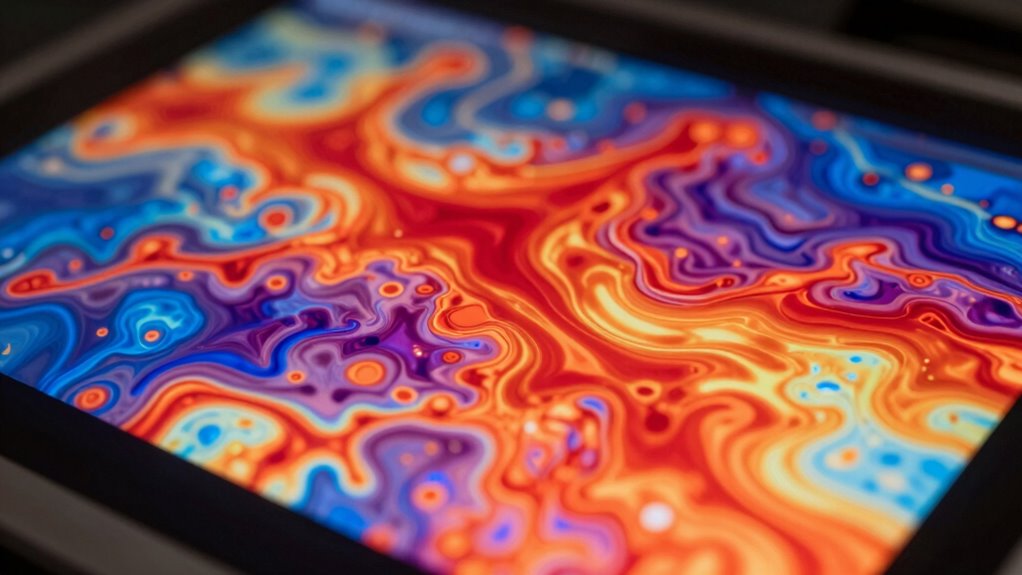
Surface heating maps are your secret weapon because they give you detailed insights into urban heat hotspots, helping you plan smarter cooling strategies and green spaces. They highlight vulnerable zones, allowing you to prioritize interventions like tree planting or reflective surfaces. These maps support more effective infrastructure investments and climate resilience efforts. By integrating real-time data, you can stay ahead of heat risks and design cooler, safer environments. Want to discover how these tools can empower your urban planning decisions?
Key Takeaways
- They enable precise identification of heat hotspots, allowing targeted mitigation efforts.
- Provide real-time, detailed data to support proactive urban planning and climate resilience strategies.
- Help prioritize interventions like green spaces and reflective surfaces to reduce urban heat islands.
- Support data-driven decision-making for infrastructure investments and emergency response.
- Enhance understanding of heat distribution patterns, improving climate models and adaptation measures.

Surface heating maps have become a powerful, yet often overlooked, tool in various industries. They reveal detailed insights into how heat distributes across different surfaces and environments, offering critical data that can transform decision-making processes. In urban planning, these maps are invaluable. They help city planners identify heat hotspots, which are often caused by concrete, asphalt, and other heat-absorbing materials used extensively in cities. By understanding where the most intense heat accumulates, you can design more sustainable urban landscapes. Incorporating surface heating data allows you to plan greener spaces, reflective surfaces, and shaded areas that mitigate the urban heat island effect. This proactive approach not only enhances residents’ comfort but also reduces energy consumption for cooling, leading to more sustainable cities.
When it comes to climate adaptation, surface heating maps become even more essential. Climate change intensifies extreme heat events, making it necessary to anticipate and prepare for temperature spikes. These maps give you a clear visualization of vulnerable zones, enabling targeted interventions. For instance, you can prioritize planting trees in areas prone to extreme heat or revise building codes to include heat-resistant materials. They also support emergency preparedness by pinpointing regions that might experience dangerous heat levels during heatwaves. With this data, you’re better equipped to develop strategies that protect vulnerable populations and infrastructure. Additionally, real-time data collection from surface heating maps enhances the accuracy of climate models, allowing for more precise planning. Incorporating advanced sensing technology further elevates their effectiveness by providing up-to-the-minute insights. Moreover, understanding urban heat island effect can help cities develop more effective cooling strategies. Recognizing the importance of climate resilience, these maps help communities adapt more effectively to changing conditions. A deeper understanding of heat distribution patterns can also guide targeted infrastructure investments to improve overall urban thermal comfort.
Using surface heating maps, you gain an edge in designing resilient environments that adapt to changing climate conditions. They provide real-time, spatially detailed information that traditional climate models can’t match. This precision allows you to implement adaptive measures efficiently—be it urban cooling strategies, infrastructure improvements, or community outreach programs. Additionally, these maps can be integrated into planning software, making it easier for you to simulate future scenarios and evaluate the effectiveness of proposed measures. In doing so, you can make smarter, data-driven choices that balance development with climate resilience.
Ultimately, surface heating maps are a secret weapon because they combine scientific accuracy with practical application. They give you the power to make informed decisions that improve urban environments and bolster climate resilience. Whether you’re designing a city’s infrastructure or preparing for heatwaves, these maps provide the insights needed to act decisively. As climate challenges grow, leveraging this technology ensures you’re not just reacting to heat but actively managing and reducing its impacts. In a world where heat is becoming an increasingly pressing issue, surface heating maps are your best tool for creating cooler, safer, and more sustainable spaces.
urban heat map software
As an affiliate, we earn on qualifying purchases.
As an affiliate, we earn on qualifying purchases.
Frequently Asked Questions
How Accurate Are Surface Heating Maps in Different Environments?
Surface heating maps are quite accurate across different environments, but their precision varies. In urban heat zones, they effectively capture heat islands caused by concrete and asphalt. In forest canopies, they can be less precise due to dense foliage blocking heat signals. You should consider environmental factors when interpreting these maps, as urban heat typically shows higher temperatures, while forest canopies tend to be cooler and more complex to analyze.
What Are the Limitations of Surface Heating Map Technology?
You might think surface heating maps are flawless, but their limitations lie in detecting subtle thermal anomalies and data resolution constraints. Poor resolution can hide critical details, while complex environments may produce misleading thermal readings. External factors like weather or surface materials can skew results. So, despite their power, these maps aren’t foolproof—they require careful interpretation and sometimes, supplementary data to guarantee accuracy.
Can Surface Heating Maps Predict Future Temperature Changes?
Yes, surface heating maps can help predict future temperature changes. Your urban planning efforts can benefit by identifying heat hotspots and implementing cooling strategies, reducing urban heat islands. These maps also inform renewable energy projects, like solar panel placement, by showing areas likely to experience higher temperatures. By analyzing trends, you can make smarter decisions that enhance sustainability and resilience in your community, leveraging surface heating maps as a valuable forecasting tool.
How Do Surface Heating Maps Integrate With Existing Climate Models?
You integrate surface heating maps into climate models by combining real-time data on urban heat and vegetation effects. These maps enhance model accuracy, showing how urban areas intensify heat retention and how vegetation mitigates it. By inputting this data, your models better predict temperature changes, revealing hotspots and cooling zones. This integration helps you develop targeted strategies to combat urban heat, making climate predictions more precise and actionable.
What Industries Benefit Most From Using Surface Heating Maps?
You’ll find urban planning and agricultural management benefit most from surface heating maps. In urban planning, these maps help optimize city layouts to reduce heat islands and improve sustainability. For agriculture, they guide irrigation and crop selection by highlighting temperature variations. By actively using these maps, you can make informed decisions to enhance efficiency, reduce costs, and promote environmental resilience in both sectors.
surface heating sensors
As an affiliate, we earn on qualifying purchases.
As an affiliate, we earn on qualifying purchases.
Conclusion
Now, picture yourself wielding this secret weapon—surface heating maps—like a master strategist. As you scan the terrain, heat signatures reveal hidden truths beneath the surface, illuminating paths unseen and threats lurking in the shadows. With this tool in your hands, you can navigate with confidence, turning the unknown into your advantage. It’s your silent partner, a flicker of heat in the darkness guiding your way to success.
green space planning tools
As an affiliate, we earn on qualifying purchases.
As an affiliate, we earn on qualifying purchases.
reflective surface materials for cities
As an affiliate, we earn on qualifying purchases.
As an affiliate, we earn on qualifying purchases.