
To master multi-layer soaring, you need to learn how to change smoothly between thermals, ridge lift, and wave. Start by identifying the characteristic cloud formations and landscape cues for each lift type. Use thermals for initial altitude, then shift to ridge lift along mountain slopes as wind conditions favor. When stable air and lenticular clouds appear aloft, switch to wave lift for sustained, high-altitude soaring. Understanding these shifts enhances your efficiency—exploring each step will reveal how to make the most of every lift zone.

Get travel and outdoor gear delivered free with Prime
- Fast, free delivery on millions of items
- Prime Video, Amazon Music and more included
- Member-only deals all year
Key Takeaways
- Recognize cloud indicators such as cumulus, lenticular, and cloud lines to identify thermal, ridge, or wave lift zones.
- Transition smoothly by observing landscape and wind cues to shift from thermals to ridge lift or wave lift.
- Use thermals for initial altitude gain, then move along ridges or into wave systems for sustained soaring.
- Adjust flight techniques based on lift type: circle in thermals, follow terrain for ridge lift, and ride wave undulations.
- Maintain situational awareness of weather patterns and cloud formations to optimize multi-layer soaring strategies.
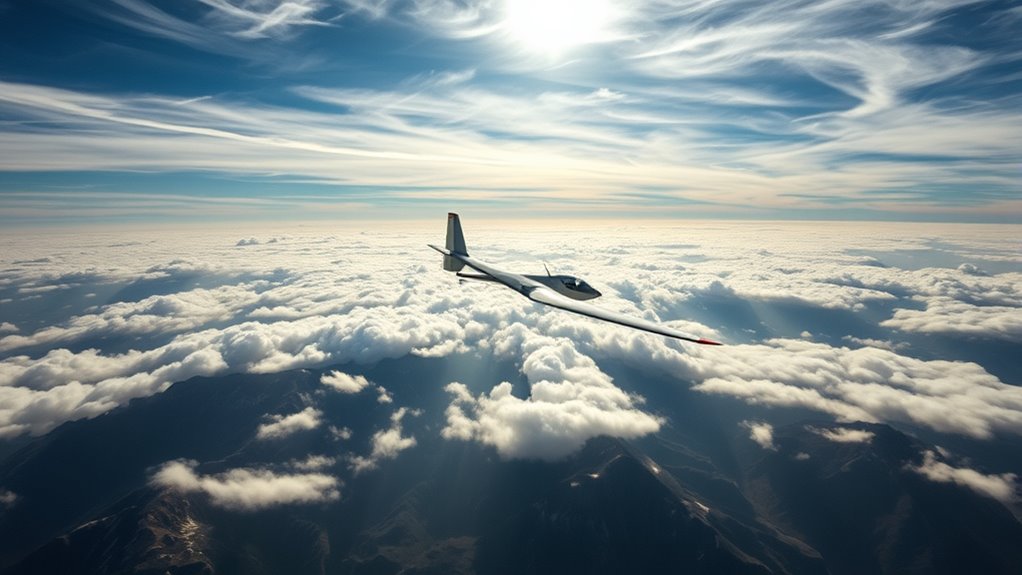
Have you ever wondered how glider pilots stay aloft for hours without an engine? It all comes down to understanding and utilizing different lift sources like thermals, ridge lift, and wave. Shifting between these lift types requires keen observation, skill, and an understanding of cloud formations, which directly influence aircraft performance. Each lift source offers unique advantages, and knowing how to switch seamlessly between them can extend your flight duration considerably.
Thermals are columns of rising warm air that form when the sun heats the Earth’s surface unevenly. As you watch the sky, you notice cumulus clouds with flat bases and puffy tops—these are classic indicators of thermal activity. When you spot these clouds, you realize they mark areas where warm air is rising vigorously, providing a reliable source of lift. Your aircraft performance improves as you circle within these thermals, gaining altitude and conserving energy. The size and strength of thermals vary depending on weather conditions, but recognizing their cloud formations is key to staying aloft longer. Once you’ve gained enough height, you can glide towards other lift sources or prepare for a shift to ridge or wave lift.
Thermals are rising warm air columns indicated by cumulus clouds with flat bases and puffy tops.
Ridge lift occurs when wind blows against a mountain or hill, forcing air upward along the terrain’s slope. You can identify potential ridge lift areas by observing the landscape and wind direction. When approaching a ridge, pay attention to the wind streaks and the way clouds form along the terrain; often, you’ll see a line of clouds or a smooth, lenticular shape indicating strong lift. Aircraft performance when exploiting ridge lift is often steady and predictable, allowing you to maintain altitude with minimal effort. Shifting from thermals to ridge lift requires a keen eye for these subtle cues and an understanding of how terrain influences airflow. When the lift weakens or you need to gain more height, moving along the ridge to find stronger or more consistent lift becomes essential.
Wave lift is the highest and most sustained form of lift, occurring when stable atmospheric conditions cause air to oscillate in a series of standing waves over mountain ranges. Recognizing wave conditions involves observing specific cloud formations like lenticular clouds, which sit in the lee of mountains and indicate strong wave activity. Aircraft performance in wave lift can be exceptional, allowing for extended flights at high altitudes. Shifting into wave lift means you need to identify the right cloud patterns and understand wind patterns aloft. Once in wave lift, you can often soar for hours, riding the undulating air currents that stretch high above the terrain. Mastering the art of shifting smoothly between thermals, ridge lift, and wave lift ultimately enhances your soaring experience and maximizes your flight time.
As an affiliate, we earn on qualifying purchases.
Frequently Asked Questions
How Do Pilots Recognize Multiple Lift Layers Visually?
You recognize multiple lift layers by observing visual cues like distinct cloud patterns and changes in the sky’s appearance. Look for different types of clouds, such as cumulus for thermals and lenticulars or wave clouds for wave lift. Notice shifts in cloud altitude, color, and texture, which indicate progression between lift layers. These visual clues help you identify when you’re moving between thermals, ridge lift, and wave, keeping your flight efficient and safe.
What Are the Risks of Transitioning Between Different Lift Types?
When switching between different lift types, you face risks like unexpected turbulence or losing lift altogether. Thermal layering can cause sudden changes in lift strength, making it tricky to maintain altitude. During lift shifts, you might encounter shifts in the air, leading to stalls or unanticipated sink. Staying alert and adjusting your speed and heading helps manage these risks, ensuring a smoother changeover and safer soaring experience.
How Does Weather Forecasting Assist Multi-Layer Soaring Planning?
Weather forecasting helps you plan your multi-layer soaring by predicting conditions like wind shear and cloud formations, which indicate lift sources. For example, knowing that a warm front will produce stable cloud formations allows you to anticipate shifts between thermals and wave. By understanding these forecasts, you can optimize your route, avoid dangerous wind shear zones, and make safer, more efficient decisions during your flight.
What Equipment Modifications Improve Multi-Layer Soaring Performance?
You can improve your multi-layer soaring performance by upgrading your winglets for better lift and stability, especially during layer changes. Adjust your aileron trim for smoother control and reduced fatigue when steering through different lift layers. These modifications help maintain optimal flight paths, enhance maneuverability, and conserve energy, allowing you to stay comfortably in thermals, ridge lift, and wave for longer periods, ultimately boosting your overall soaring experience.
How Do Pilots Adjust Their Strategies for Multi-Layer Environments?
You adjust your strategies by actively using thermal detection and ridge identification to navigate multi-layer environments. When you sense rising air, you circle to maximize lift, shifting between thermals and ridge lift seamlessly. You stay alert for wave patterns at higher altitudes, adapting your altitude and course accordingly. Constantly monitoring your environment helps you make smooth shifts, optimizing your glide and maintaining altitude across different layers of lift.
Conclusion
As you glide through these layered skies, each lift becomes a chapter in your flight’s story—thermals, ridge lifts, and waves weaving together like a symphony of wind and hope. Embrace the dance of the air, where every progression symbolizes resilience and freedom. Let the sky be your canvas, the layers your brushstrokes, guiding you higher with every shift. In this endless ballet, you find not just altitude, but the spirit of soaring itself.
Fall Picks
fall essentials
As an affiliate, we earn on qualifying purchases.