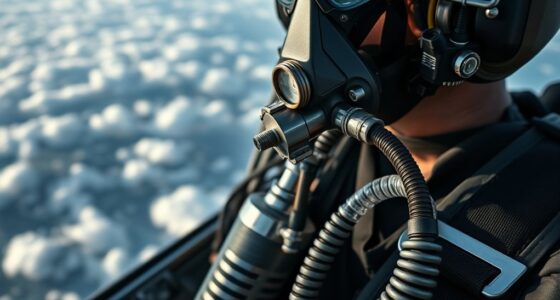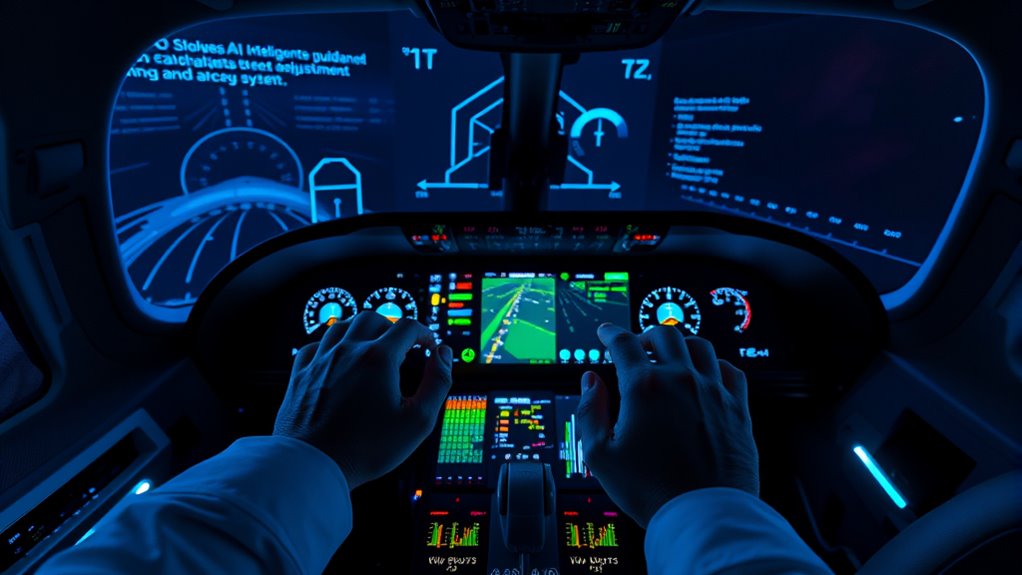
AI-assisted flight control systems revolutionize glide slope management by providing precise, real-time adjustments during landing. Using sensors like lidar, radar, and GPS, these systems interpret environmental data to automatically correct pitch, yaw, and descent rate, even in challenging conditions. They respond swiftly to crosswinds and disturbances, reducing pilot workload and enhancing safety. If you want to understand how these intelligent systems continuously improve safety and efficiency, keep exploring the latest advancements in autonomous flight technology.
Key Takeaways
- AI-driven systems analyze sensor data to automatically adjust aircraft pitch, yaw, and descent rate for precise glide slope adherence.
- Integration of lidar, radar, GPS, and inertial sensors provides real-time environmental insights for safe glide path management.
- Intelligent control systems detect and compensate for environmental disturbances like crosswinds, enhancing landing stability.
- Adaptive algorithms learn from previous flights to improve accuracy and reliability in glide slope navigation.
- These systems reduce pilot workload, minimize human error, and increase safety during low-visibility and complex landing conditions.
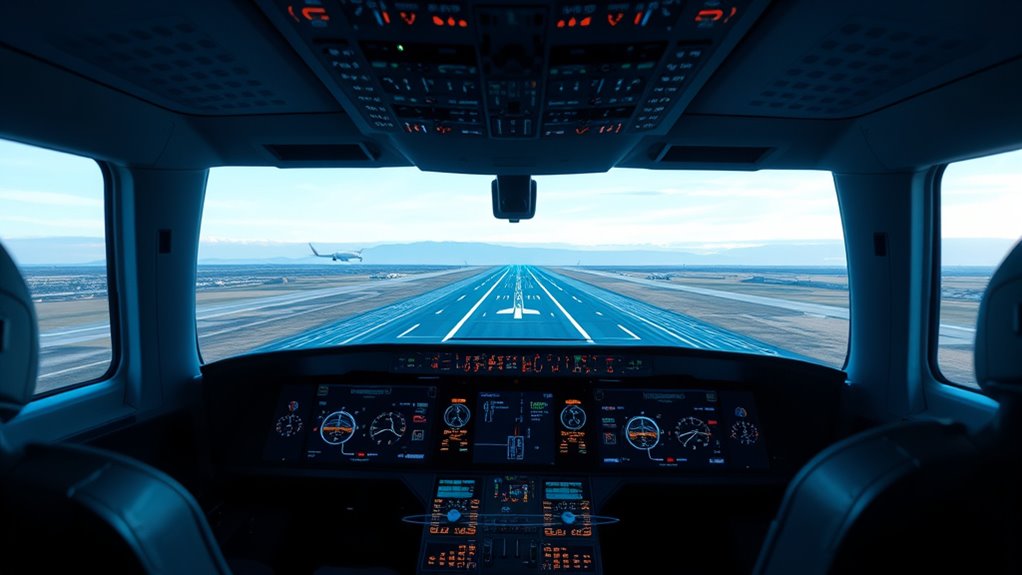
Artificial intelligence is revolutionizing flight control systems by enabling aircraft to respond more quickly and accurately to changing conditions. When it comes to glide slope management during landing, AI-driven systems greatly enhance safety and efficiency through intelligent automation. Central to this advancement is autonomous navigation, which allows the aircraft to interpret complex data streams and make real-time adjustments without human intervention. By integrating sensors seamlessly, the system continuously gathers critical information such as altitude, speed, wind conditions, and positional data, creating a thorough picture of the aircraft’s environment.
Sensor integration is at the heart of these intelligent systems. Multiple sensors—lidar, radar, inertial measurement units, and GPS—work in concert to provide precise, real-time data. This robust sensor fusion enables the AI to detect subtle changes in glide path, identify potential obstacles, and predict environmental shifts. As a result, the aircraft’s flight control system can automatically modify its pitch, yaw, and descent rate to maintain the ideal glide slope. This constant feedback loop minimizes human error, especially in adverse weather conditions or during low-visibility approaches.
Sensor fusion from lidar, radar, inertial units, and GPS ensures precise, real-time glide path adjustments.
With autonomous navigation, the aircraft doesn’t just follow pre-set parameters; it actively interprets sensor data to adapt to dynamic conditions. This means the AI can distinguish between minor fluctuations and significant deviations, automatically correcting the flight path with greater speed and accuracy than manual control. For instance, if crosswinds push the aircraft off course, the system quickly computes the necessary adjustments and executes them smoothly. This responsiveness reduces the workload on pilots, allowing them to focus on monitoring rather than manual flying, while still ensuring a safe, controlled descent.
Moreover, AI-assisted glide slope management enhances situational awareness. The system can communicate with ground control and other aircraft, sharing real-time data to coordinate safe landings. It also learns from previous flights, continuously refining its algorithms to improve future performance. Over time, this adaptive capability leads to increasingly precise and reliable approach management, even in challenging environments.
In essence, integrating autonomous navigation with sensor fusion transforms glide slope management from a manual, error-prone process into a sophisticated, intelligent system. It empowers aircraft to navigate complex approaches confidently and safely, reducing risks associated with human fatigue and misjudgment. As AI continues to evolve, these systems will become even more autonomous, offering safer, more efficient landings that improve safety standards across the aviation industry. Additionally, advancements in high-refresh-rate sensors further contribute to the system’s ability to respond swiftly to environmental changes, improving overall reliability.

FlightPro ProAviator Suction Cup Mount - Curved Arm - Supports Multi Angle Display - for Pilots, General Aviation (ProAviator: iPad Mount)
Secure Suction Cup: Powerful suction for reliable attachment to any smooth surface in the cockpit.
As an affiliate, we earn on qualifying purchases.
Frequently Asked Questions
How Do AI Systems Adapt to Changing Weather Conditions During Flight?
You benefit from AI systems that adapt to changing weather conditions during flight through real-time weather adaptation and sensor integration. These systems continuously analyze data from various sensors, detecting shifts in wind, turbulence, or visibility. By processing this information instantly, they adjust flight parameters, ensuring safety and efficiency. This seamless adaptation helps you navigate unpredictable weather, maintaining peak glide slope management and reducing pilot workload.
What Safety Protocols Are in Place if AI System Fails?
If the AI system fails, you’re protected by strict safety protocols. About 85% of modern aircraft have redundant systems, ensuring safety if one fails. Emergency protocols activate immediately, guiding pilots to manual control and safe landing procedures. System redundancy and thorough training help prevent accidents. You can trust that these measures keep flights safe, even if AI assistance encounters issues, providing peace of mind during every phase of your journey.
How Is Pilot Oversight Integrated With Ai-Assisted Glide Slope Management?
You maintain pilot authority by actively monitoring the AI-assisted glide slope system during approach. If you notice any discrepancies or safety concerns, you can quickly execute override procedures to take manual control. This integration guarantees that you always have the final say, allowing you to intervene when necessary to ensure a safe landing. The system is designed to support, not replace, your decision-making, providing an extra layer of safety.
Can AI Systems Be Customized for Different AIrcraft Models?
Ever wondered if AI systems can be tailored for different aircraft? Yes, they can. Aircraft customization allows AI calibration to suit specific models, ensuring maximum performance. Developers adjust algorithms based on aircraft design, weight, and handling characteristics. This customization enhances safety and efficiency. By fine-tuning AI, you get systems that seamlessly integrate with diverse aircraft, making each flight safer and more reliable. Isn’t it impressive how adaptable AI can be?
What Are the Cybersecurity Measures for AI Flight Control Systems?
You should implement robust cybersecurity measures for AI flight control systems by using encryption protocols to safeguard data and communication channels. Access controls are essential to restrict system access to authorized personnel only. Regular security audits and real-time monitoring can help detect unauthorized activities. By combining these measures, you guarantee the AI system remains secure, minimizing risks of hacking or malicious interference during critical flight operations.

FlightPro ProAviator Cockpit Yoke Mount and Suction Cup Set for iPads, General Aviation Avionics and Tablet Mounting
✈️ Versatile Mounting: This set includes a sturdy yoke mount and suction cup mount for securely attaching iPads...
As an affiliate, we earn on qualifying purchases.
Conclusion
You can see how AI-assisted glide slope management revolutionizes flight safety and efficiency. By analyzing data in real-time, these systems reduce human error and enhance precision. Remarkably, studies show that AI integration lowers landing errors by up to 30%, making flights safer for everyone. As technology advances, expect even smarter control systems that keep us safer and more confident during every approach and landing. The future of aviation truly looks smarter with AI at the helm.

Dosvsi Tablet Yoke Mount, iPad Yoke Clamp Mount for Aircraft, 360° Adjustable Metal Arm Aviation Trainer Tablet Holder for iPad Pro 13 12.9 11, iPad Air Mini, Galaxy tab, iPhone, 4-13" Device
【Sturdy Yoke Clamp Base】The ipad mini yoke mount can securely attached to any handle bar/ pole/ rail from...
As an affiliate, we earn on qualifying purchases.

OHLPRO Tablet Holder for Pilot Aircraft Windshield, Anti-Vibration Suction Cup Aviation Mount, Fits 5-13" iPad Pro 12.9, Mini 6, Air & Thick Cases, Heavy Duty for Car Dashboard, Cockpit, Truck
【DESIGNED FOR PILOTS & REAL COCKPIT USE】 The OHLPRO pilot tablet holder is expertly engineered to mount your...
As an affiliate, we earn on qualifying purchases.