
A spotting scope helps on the ground more than in the air by providing clearer, more detailed views of distant wildlife and landscapes. Its powerful optics allow you to see intricate feather patterns, subtle movements, and natural features without disturbing animals. The stability from its tripod and high magnification make it easier to spot and study subjects in low-light or distant conditions. Keep exploring, and you’ll discover even more ways a spotting scope can enhance your outdoor experience.
Key Takeaways
- Provides detailed views of distant ground subjects, revealing intricate features and behaviors not visible with binoculars or naked eye.
- Enhances low-light and dawn/dusk observations, ideal for spotting wildlife on the ground during peak activity times.
- Stabilizes images through tripods, reducing shake for clearer viewing of stationary ground-based targets.
- Offers superior magnification and optical clarity, making it easier to identify species and study features from afar.
- Allows prolonged, comfortable observation of ground wildlife without fatigue, thanks to ergonomic design and stability.
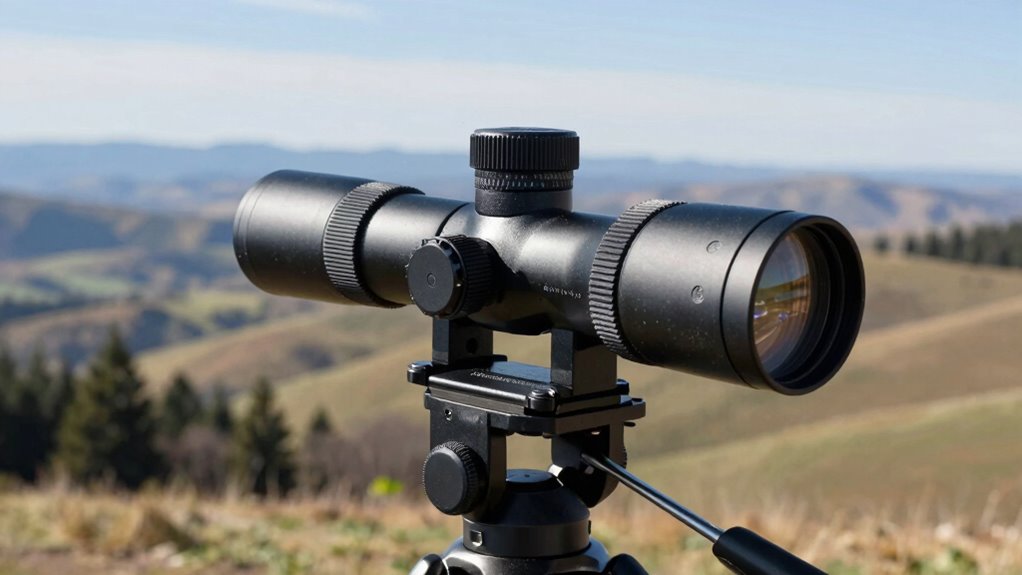
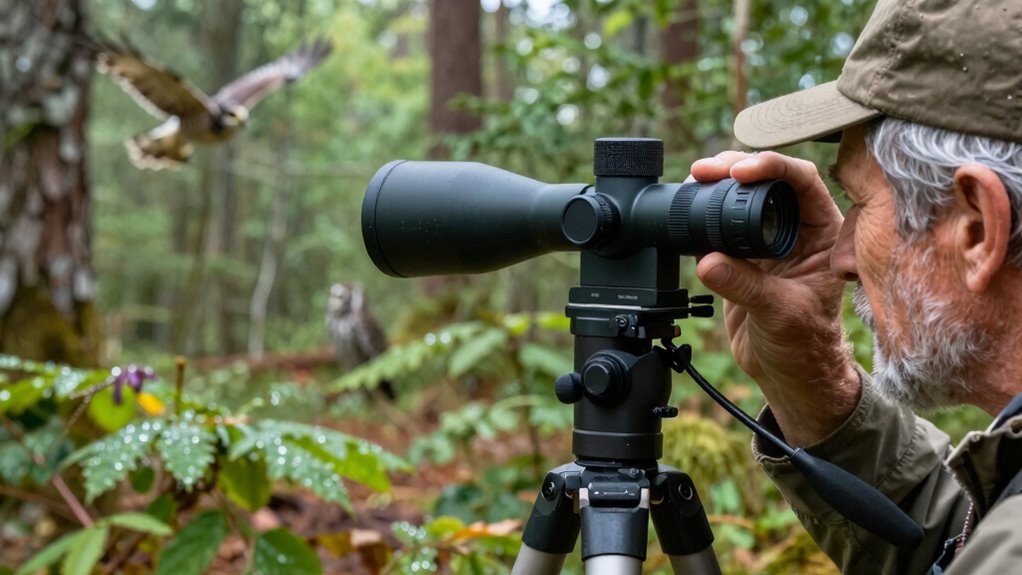
A spotting scope is an indispensable tool for ground-based observation, offering clarity and detail that binoculars or naked eye viewing often can’t match. When you’re out in the field, whether bird watching or engaging in wildlife observation, a spotting scope gives you a closer look at distant subjects with sharpness and precision. Unlike binoculars, which are great for quick scans, a spotting scope provides high-powered magnification that reveals intricate feather patterns, subtle movements, and fine features, making it easier to identify species and appreciate their behaviors.
A spotting scope reveals intricate details and sharpness for precise ground-based wildlife observation.
On the ground, your ability to observe wildlife at a distance becomes markedly enhanced with a spotting scope. You can spot a rare bird perched far away and distinguish its markings without disturbing it, thanks to the scope’s superior optics. This is especially useful during bird watching excursions, where every detail counts. You’ll notice the difference in how clearly you can see the colors, markings, and even the eye color of distant birds. The same applies to broader wildlife observation; animals often stay hidden or move quickly, but a spotting scope lets you observe their natural behaviors from afar without scaring them off.
The advantage of a spotting scope over air-based observation is also about stability and detail. When you’re on the ground, you can set up your scope on a tripod, reducing hand shake and allowing for steady viewing. This stability means you can spend more time observing and less time trying to hold your binoculars still. The larger objective lens of a spotting scope collects more light, producing brighter images, which is crucial when observing in low-light conditions at dawn or dusk—times when many wildlife activities occur. The detailed images you get help you study bird behavior, identify species, and enjoy wildlife observation more deeply. Additionally, optical technology advancements have further enhanced the performance of these scopes, making them even more valuable in the field.
While spotting scopes are often associated with distant viewing, they excel in ground-based scenarios because of their ability to bring distant subjects into close view with clarity. You’re able to appreciate the fine details of feathers, fur, or scales that might be missed with lesser optics. This makes them indispensable for serious bird watchers and wildlife enthusiasts who want every opportunity to study their subjects closely without intrusion. Furthermore, stability and magnification are key factors that make them superior for ground observation compared to other optical devices. In addition, the light-gathering capacity of a spotting scope ensures brighter images in challenging lighting conditions, enhancing your overall observation experience. The ergonomic design of modern scopes also helps reduce fatigue during extended periods of viewing, making your outdoor experience more comfortable. Overall, a spotting scope transforms your ground-based observations into a more immersive, detailed experience, far surpassing what you can achieve with binoculars or by eye alone.
best spotting scope for wildlife
As an affiliate, we earn on qualifying purchases.
As an affiliate, we earn on qualifying purchases.
Frequently Asked Questions
What Is the Optimal Magnification for Ground Use?
For ground use in bird watching and wildlife observation, a suitable magnification ranges from 20x to 60x. This allows you to see details clearly without sacrificing stability. Higher magnifications help spot distant animals, but can be harder to stabilize. Lower magnifications provide a wider field of view, ideal for scanning. Choose a spotting scope with adjustable zoom within this range for versatile, sharp images in various outdoor conditions.
How Do Weather Conditions Affect Spotting Scope Performance?
Weather impacts your spotting scope performance considerably, especially through atmospheric distortion caused by heat waves, humidity, or fog. These conditions can blur or distort your view, making it harder to see distant objects clearly. You might notice less clarity or inconsistent image quality during extreme weather. To optimize your viewing, try to use your scope in stable weather, avoid direct sunlight, and be mindful of temperature changes that can affect image sharpness.
Can Spotting Scopes Be Used for Underwater Observation?
Imagine you’re in a sci-fi movie—spotting scopes aren’t typically meant for underwater use. They lack marine compatibility and aren’t waterproof enough for submerged observation. Underwater clarity and pressure make them ineffective, so you’d need a specialized underwater or marine scope. Regular spotting scopes are designed for land-based viewing, so for underwater adventures, it’s best to invest in gear specifically built for marine environments.
What Accessories Enhance Ground Viewing Accuracy?
To enhance ground viewing accuracy, you should invest in accessories like a sturdy tripod for better stability, reducing shakes and blurriness. Additionally, consider lenses with high-quality coatings—they improve light transmission and reduce glare, giving you clearer images. Using these accessories together guarantees your spotting scope remains steady and delivers sharp, bright visuals, making your ground observations more precise and enjoyable.
How Portable Are Spotting Scopes for Outdoor Activities?
Spotting scopes are quite portable for outdoor activities, so you can take them almost anywhere. With travel convenience in mind, they’re designed to be lightweight and compact, making them easy to carry on hikes or birdwatching trips. While some models may be a bit heavier, most strike a good balance between durability and weight. Just remember, a heavier scope isn’t necessarily better—sometimes, it’s better to keep things light to hit the ground running.
Conclusion
In the end, a spotting scope isn’t just a tool—it’s your secret weapon on the ground, transforming your view into an eagle’s eye. It’s like having a superhero’s vision, letting you spot details from miles away that others can’t even dream of seeing. Whether you’re birdwatching or on a hunt, this tiny device packs an incredible punch, giving you clarity and focus that’s nothing short of extraordinary. Get ready to see the world in a whole new way!